10 Feb 2011

Mitesh

Valentine’s Day myths busted


Think you can score some points with your girl on Valentine’s Day by gifting her chocolates, flowers or cheesy presents? Well, you can’t be more wrong, for these are some of the myths that have been busted by a website.

AskMen.com offered a quick review of some of the long-held beliefs associated with the day.

The site recommends a little bit of originality, foresight and planning can help make February 14 extra special.

Myth No. 1: It’s OK to skip Valentine’s Day

Why this is false: She might realize that it’s a hyped-up holiday, but that won’t get you off the hook completely. She’ll see her friends going on dates and wonder why you aren’t stepping up to the plate.

What to do instead: You can keep Valentine’s Day low-key and celebrate it in your own way. Plan an activity that you both enjoy and declare it your own celebration – like ice skating or hiking. Any activity that you do together will show her that you gave the day some thought.

Myth No. 2: You have to celebrate on February 14th

Why this is false: No one says you have to celebrate on the same day as everyone else – that’s so conventional.

What to do instead: Pick another day in the week to plan your date and declare that day your own personal Valentine’s Day. Places will be less crowded and you won’t be made to feel like another sheep in the crowd. She won’t care when you celebrate as long as she sees you’ve put some thought into it. She may even appreciate mixing it up.

You’re saving money for a vacation together, so it’s OK to skip Valentine’s Day

Why this is false: Even though she agreed to save money too, this is a perfect opportunity to win brownie points with her.What to do instead: Don’t plan an expensive date, but do surprise her with an inexpensive (but thoughtful) activity. Plan to meet her for lunch and pack her favorite food in a picnic basket. She’ll be impressed that you stuck to a budget while still making her feel special.

Myth No. 4: You’ve only been dating for a few months, so you won’t celebrate

Why this is false: While you might not want to do anything overly romantic with a new girlfriend, that doesn’t mean you have to ignore it. If you don’t acknowledge Valentine’s Day at all, she might wonder if you are really interested in her.What to do instead: Don’t plan anything romantic. Instead, think of a fun activity. Try scheduling in a dance class or a cooking class to mix things up. Or, take her to see a comedy show – anything to get the two of you laughing together.

Myth No. 5: Dinner is a Valentine’s Day staple

Why this is false: Dinner is an adequate Valentine’s Day plan, and I suppose you can’t go wrong with it. However, truth be told, it’s a little unoriginal.

What to do instead: Mix things up a bit. With as much effort as it takes to make dinner reservations, you can plan a date that is seeping with originality. Try a couple’s massage, jump into a hot tub (anything in a Jacuzzi is sexy), look for an old-fashioned roller-skating rink in your city, or try an artsy date by going to a museum or checking out a jazz show.

Myth No. 6: Chocolates or flowers are good Valentine’s Day gifts

Why this is false: Just like going out for dinner, chocolate and flowers are not the wrong thing to do – they’re just overly conventional.

What to do instead: Originality is worth a lot on Valentine’s Day, especially when all of her friends will be getting the usual flowers and chocolates. Stand out by getting her something out of the ordinary. Does she like to travel? Get her a subscription to a travel magazine. Does she like music? Get her concert tickets.

Myth No. 7: You need to spend loads of money on her gift

Why this is false: It’s the thought that really counts the most when it comes to Valentine’s Day.

What to do instead: Try getting her a small gift with a lot of meaning. If you are just starting to get serious, for example, buy her a pair of slippers or a robe to keep in your apartment.

Myth No. 8: Don’t expect a gift in return

Why this is false: While Valentine’s Day is usually marketed as “her” holiday, there’s no rule stating she can’t surprise you with a little something. So, chances are very good that you’ll get your box of candy.

What to do instead: If the whole guessing game about whether you’re getting a gift or not is bugging you, approach the subject of a “no gift” idea with her and make plans together for a romantic weekend getaway or a perfect night out instead.

Myth No. 9: The gift has to be cheesy or romantic

Why this is false: Just the opposite, actually. There is no rule that says you have to write her poems or sing her a song on Valentine’s Day.

What to do instead: If you’re not comfortable with the cheesiness, forget it. Just stick to getting her a fun gift. Try buying a good board game or a cool CD – then go home and play it together.

Myth No. 10: Lingerie makes a good Valentine’s Day gift

Why this is false: Actually, this myth is not entirely false. Lingerie can be a nice part of a gift for a self-assured woman, bearing in mind that you need to know her size and style preferences. But usually, she’ll like that to be part of a sexy gift – not all of it.

What to do instead: For a really sexy gift, try buying a book on massage techniques that you can learn together or – if you are good and ready for it – a copy of the Kama Sutra. (ANI)
Read More

4 Feb 2011

Mitesh

How to Get Over an Online Breakup


For weeks, the two of you may have been inseparable when you were online. Several hours passed by talking and playing online games. For those of us who are constantly online due to work, an online love seems like the perfect way to have a relationship. Other times, love just finds you while you are surfing the web. Regardless of how it began, each person must have his needs met if the relationship is to succeed. Sometimes, you find that it is best to end the relationship. Once we choose to walk away from our cyber romance we are left to deal with the constant reminder of our online relationship.

Instructions:

1.Delete his contact information. Once the ending of the relationship is final, delete his email address and his Instant Messenger address.

2.Erase all Instant Messenger archives. Women are sentimental in nature, and technology makes it even easier to save past conversations. As tempting as it is to keep sweet E-cards or emails, don’t do it. If you can’t find the heart to delete them, then store them in a folder.

3.Create a new account. If you played online role-playing games, then make a new account. It isn’t necessary that you stop playing a favorite game.

4.Chat with other people online. Get to know other people that have the same interests as you do. The Internet is massive and your online ex is not the only person whom you will form a connection with.

5.Use a different messenger program. Until the raw pain of a broken heart wears off, switch to another messenger program. For example, if you use Yahoo messenger, try using Windows live.

6.Place photographs in a folder. Most of us like to save pictures of our exes. Save all of her pictures in a folder that is out of your reach.

7.Delete your ex from your Myspace or Facebook account. Nothing is more painful than having constant updates on an ex. This applies to offline relationships as well as online ones.

8.Limit your time online, if possible. If your job does not require using a computer, try to stay offline as much as you can. Those that have to use a computer daily may find this difficult.

Read More

28 Jan 2011

Mitesh

9 things you should never assume at work


New York, Jan 25 (ANI): Do you feel that all your colleagues are friends? Or that your life is all about your job? You could be wrong.
We often make bad assumptions and then become disappointed when situations don't work out.
My job completes me - It's not your whole life, avoid the Work, Sleep, Repeat cycle or else your sense of self will erode any time your job disappoints you, reports the New York Daily News.
Your Money columnist Carolyn Kepcher, author of the best-selling book 'Carolyn 101,' tells you the top nine areas in which it's important to maintain a healthy sense of reality:
My boss reads my mind - Lobby for your promotion and take the initiative of talking to your boss about it. Many workers make the mistake of not engaging in any self-promotion at all - and then suffer the crushing disappointment of not receiving a pay raise, or a promotion.
Co-workers are friends - Although you may find friends at work, it's very important to draw boundaries. Unlike friendships or romances gone awry, you have no choice but to see your co-workers every single workday.
Salaries are set fairly - It's your responsibility to negotiate for a higher salary. Employers will pay what they feel they need to pay to hire and keep an employee, and nothing more.
H.R. is here to help me - They will help you, but their true job is to protect the organization. There are certain areas in which it may be best not to seek the H.R. department's assistance, such as using them as a shoulder to cry on for your every workplace woe.
You aren't indispensable - Millions of workers learned that their jobs are not as secure as they once thought. Being valuable is realistic, feeling irreplaceable is not.
My personal life is my business - only as long as something that reflects poorly upon your employer. For example, you're probably not free to bad-mouth them on Facebook. Even if you do not face disciplinary action, your future career will take a hit.
I'll sue - Don't be naive. Filing a lawsuit alone takes a lot of money. Even if you are right, sometimes your only decision is whether to stay or to go. Righting wrongs can be a very costly mission.
My bosses are cool when i slack off - Do not take your job for granted. While you're accepting their pay, it's important to honour your end of the bargain, or expect them to reward your poor attitude by bestowing your job to someone who actually wants it. (ANI)


Read More

1 Jan 2011

Mitesh

Another Year has Passed by....


Another Year has Passed by in a flash. Had lots of goals to set, just few of them were achieved, happy about that, rest of the goals along with few new goals need to set this year.

A warm welcome to the coming new year ,hope all of you have a wonderful year ahead . wishing you all a happy New year.
cheers :)
Read More

25 Dec 2010

Mitesh

Alibaug office Picnic 23-24 Dec 2010


Office Picnic After a Log Gap of 2 years . Had lots of fun ! :)

It was the 6th foundation day of our organization. i was privileged as the "Employee of the Year" troffy.
was a surprise to me, but rest of the staff looked pretty sure that i would be awarded this year.
i guess hard work always pays off with good award ;) .

have nice 2 day off now. would resume work on Monday.

cheers :)


Read More

10 Feb 2009

Mitesh

why windows takes so long to start up ?

Most of us have had a brand new computer at one time. It's a great feeling. You boot up windows and within 30 seconds you are surfing the net, checking your email, or playing your favorite game. 10 months down the road things aren't so nice anymore. You power up your computer and it seems to take forever to load.

Even when you are careful about what you install it seems that each day it takes longer for it to boot. It's not your imagination - and there are a couple of good tips to keep your boot time short and sweet.

As always - backup your system before you start any of this. If you make a mistake you might need to restore from backup

Update (09/08/2006) - There has been some controversy about the prefetch folder. I think this issue needs to be looked into. I did have a reputable source for this information: It was the "Windows XP Annoyances" book by O'Reilly. Page 210. Titled "Keeping an eye on prefetch"

1. The prefetch cache

The first tip I want to talk about is the windows prefetch. Windows XP has this feature that loads commonly used programs - at boot time.

Here is how it works: Yesterday you used MS Word, and Duke Nukem 3D. Today you boot your system to check e-mail. It sees parts of these two programs in the prefetch folder and loads them into memory before windows completes the boot process. The benefit is faster application launch times. If you really wanted to use MS Word, it would pop up really quick when you double clicked on it.

The problem is most people have been running windows for years, and the prefetch gets clogged with stuff that you almost never use. Windows takes forever to boot because it is prefetching a 1.0 copy of Napster, and you just want to check your email before you have to go to work.

What can be done about it? Well there are a few things we can do to tweak the prefetch cache. One method is to disable it partially, and this can be done quite easily.

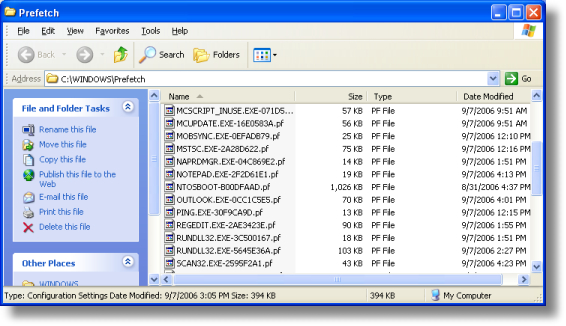
Simply browse to the windows folder (Ex: C:\Windows) and under there you should see the prefetch folder. Go into the prefetch folder and delete all the files (Careful! It should look like this c:\windows\prefetch) And here is a screenshot of one if you still have questions

The first thing to note is the next reboot will be slow. This is because windows needs to relearn the prefetch for system files. Subsequent boots will run much faster since the sludge of programs has been removed, and only new ones are in the cache.

The trouble is that it will only help you for a while - until the prefetch gets clogged up again. We need to edit a registry key to tweak it. Open regedit and browse to this key:

HKEY_LOCAL_MACHINE\SYSTEM\CurrentControlSet\Control\Session Manager\Memory Management\PrefetchParameters

Under this key you should see a value named: EnablePrefetcher

It has 4 possible values:

0 - Disabled : The prefetch system is turned off.

1 - Application : The prefetch only caches applications.

2 - Boot : The prefetch only caches boot system files.

3 - All : The prefetch caches boot, and application files.

We don't want to disable it entirely. This would actually make boot times *longer*. This is because this feature is also used to speed up the loading of boot files. That is why we are going to pick the number 2 option. It allows us to keep the advantage of caching system files, without continually clogging the system up with applications.

Set the value to 2 and reboot.

The 2nd time you boot it should boot much faster. Remember that the side effect is that launching individual applications once windows has loaded will now be slightly slower.

2. Hard drive fragmentation

Over time your hard drive will become fragmented. An over simplified explanation of fragmentation is when your files and folders are not all stored in the same spot. For example lets say you had a large movie file. If it were fragmented the first 5 megabytes are at the beginning of the hard drive, and then next 5 are at the end. It takes longer for windows to read the file than it would if it were all in the same spot. The point is that if each file is stored in a linear fashion, and the drive does not have to move all over the place to read it - it will load faster. XP has a built-in defrag tool, and it is simple to run. Open "My Computer" right click on the boot drive, and go to properties. Now click on the tools tab.

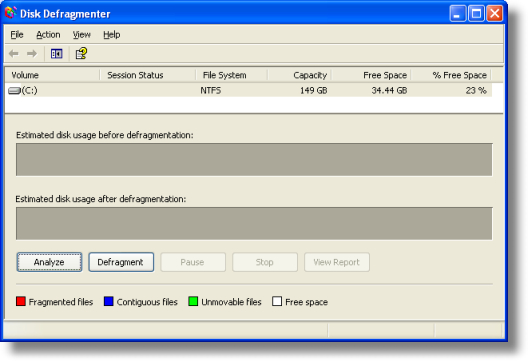
Click "Defragment Now" and the following window should appear:


Before you click on the "Defragment" button you want to close all applications and be aware that it might take hours to complete. If you leave something running it might keep windows from completing the defragment operation.

Click on the defragment button and you can walk away. Or you can watch it defrag your hard drive:

3. Disconnected network drives

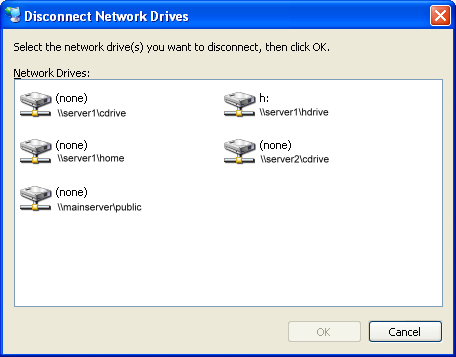
I am using networked drives all the time. If you have ever put your machine on a network and connected to a shared drive, this can slow you down too. If you have a drive that is still mapped, but cannot be reached it will slow down windows during boot time. This is because windows will wait...wait...and wait some more for the remote server to respond. To clean these out open "My Computer" and go to the tools menu. Click on "Disconnect Network Drives" It will open a window that looks like this:


Click on the drives you no longer need, and click OK.

4. Spyware & Adware

These can have a big impact on your start times. If your PC gets loaded with spyware, it spends a large portion of its boot time making sure those pesky programs are loaded and ready to throw popup adverts at you all day. To check and clean your system of spyware there are three free programs that I highly recommend:

1. Microsoft Windows Defender

2. Ad-Aware

3. SpyBot Search And destroy

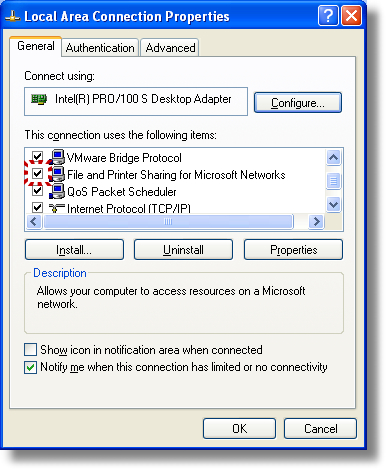
5. File and Printer Sharing

One other item that can significantly impact is the "File and Printer Sharing" feature within windows. Obviously, if you are sharing your printer, or folders you don't want to disable this - so this tip is not for you. If you never use it, then why waste your time waiting for it to load?

Here is how to turn it off:

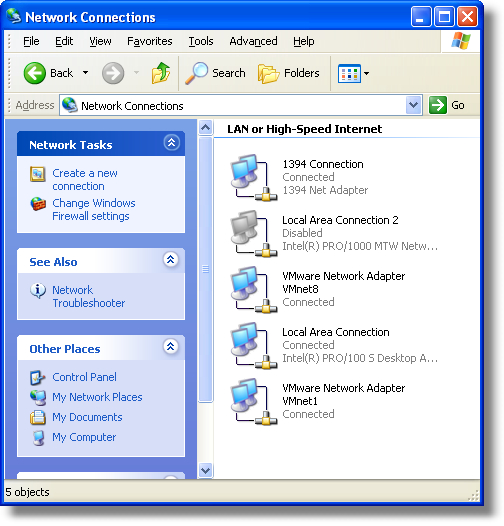
Go into the control panel. Click on "Network Connections"


Now right click on "Local Area Connection" and click on properties

Uncheck the "File and Printer Sharing for Microsoft Networks"

Click OK, and reboot.

That wraps up our windows startup optimization. And if you are tired of waiting for windows to shutdown, then check out our article on speeding that up too!

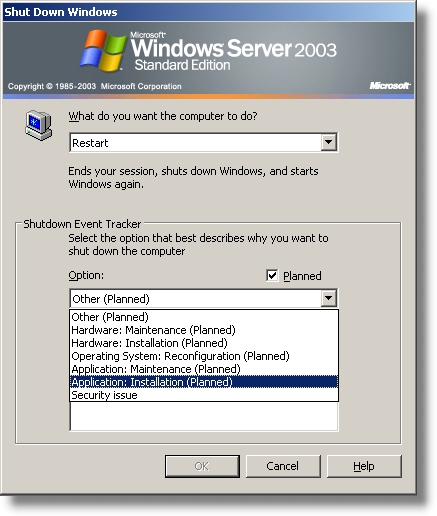
Stay tuned. We are about to release a new version of our Remote Reboot program. This version adds a feature suggested by David in our forum. It allows you to specify the shutdown reason that is written to the event log on Windows XP, and 2003. If you are not sure what I am talking about...this should remind you:

One final note, if you have any ideas for a free utility you would like to see, please put you comments on this.

courtesy : intelliadmin.com
Read More

5 Jan 2009

Mitesh

Top ten relationship wreckers

Jealousy, money, the need for space and excessive use of the Internet are just a few things that can cause relationship
10 relationship wreckers strife.

Relationships are changing faster than ever before — and so are the triggers for break-ups. New issues not even dreamt about 20 years ago, such as chatroom romances and online pornography, have risen to prominence. Here is the authoritative guide to what’s going up and what’s going down in the argument charts — and how to stop your relationship being derailed:

1. Low expectations
We expect relationships to fail. The “all men are jerks” mind set and “all women are bunny boilers” mentality has spread from being a joke with our mates into a self-fulfilling prophecy. We wait for our new boyfriend or girlfriend to trip up and then zoom in on their mistakes. Today’s couples think they are being realistic, but often this is just cynicism in disguise. Twenty years ago, couples saw marriage as an end in itself and were prepared to compromise to sustain their relationship. Therefore, they were more trusting and ready to give their partner the benefit of the doubt.
Solve it:
When people ask how many of my clients’ relationships are beyond help, my answer always surprises them: less than five percent. I believe that we make fundamentally good choices. So why so much divorce and misery? Everybody’s childhood leaves them with relationship dilemmas inherited from watching their parents’ marriage. It might be ‘not showing feelings’, ‘how to cope with unfaithfulness’ ‘temper tantrums’ or ‘attitudes to loss’ — the list in endless. We are drawn to people not just because of their great sense of humour or looks, as we imagine, but because they have similar problems to our own.


2. Work/life balance
Today we are working longer hours, doing more shift work, commuting further and therefore spending less time together than twenty years ago. When we’re tired, communication is cut down to the bare essentials (‘What time will you be back?’) as you cross paths in the kitchen. Although this shorthand is very efficient, there is no time to explain the complexity of our feelings. Into the gap leap all sorts of assumptions and misunderstandings. For example Rahul, a forty year-old chartered accountant, did not realise the importance of attending his partner’s company social. He did not understand why she was so huffy the next morning and just put the atmosphere down to a hangover but was in too much of a hurry to ask. In the past, couples would stay up half the night fighting, and probably solve the argument; today they are too aware of that early meeting to want to waste precious sleep time. Instead we complain that our partner never listens.
Solve it:
Invest in your relationship by setting aside ‘sacred time’ that belongs to just the two of you. For example: make Thursday night your date night — even if you can’t go out, spend the time talking, listening to music or making love. Many couples in therapy find they benefit most from the concentrated, quality time they spend together, rather than the counselling. Secondly, don’t make assumptions but check out your hunches.

3. Jealousy
Stories of celebrity infidelity and the divorces of supposedly ideal couples (like Jennifer and Brad) reinforce just how many people stray. Twenty years ago, we had a much clearer idea of right and wrong. But what constitutes being unfaithful today? Is it looking too long at a pretty face in the street? What about a long lunch with an admirer that you don’t tell your partner about? Is it ok if you stop at just a kiss
Solve it:
Jealousy is a sure sign of poor self image: “I’m not good enough to be loved.” Rather than relying on your partner to give
you confidence, find ways of giving yourself a boost, like going to the gym or taking evening classes. Next make a list of the occasions when you feel jealous. Try to tolerate, without resentment, the incidents that cause lower levels of jealousy. Over time, your partner will notice — probably subconsciously at first — that you have relaxed and are not monitoring him or her round the clock. He or she will then be more receptive to discussing the occasions that give you real stress — like the office Christmas party or going away on business without you. So how do you start this conversation ? First point out what you’ve achieved: “I’ve not been commenting about other men or women in the street or on television.” Secondly, talk about your fears about the up-coming event and how they make you feel. Finally ask if he or she can suggest anything they’d feel comfortable doing that might help. Agreeing to phone every evening at the same time or going away the next weekend together so there’s something to look forward to. It always feels better if these things are offered rather than having to demand them. All it takes is a little effort and understanding.

4. The internet
The arguments are not just how much time is spent on the Internet — for work or pleasure — but about starting deep ‘friendships’ in cyberspace and viewing pornography. Research among 1,500 adults found that 46 per cent believed emails, texting and chatrooms had led to a big rise in infidelity; 30 per cent had used electronic communication to flirt, or to sustain an affair; 22 per cent of them had done it every day and 62 per cent had done it once a week. In the past, few men had access to porn beyond top-shelf publications and most were too embarrassed to buy them. Today’s Internet porn is more extreme: we are bombarded with adverts for it. What’s more, the technically competent woman can trace every site her man has visited.
Solve it:
These problems need to be nipped in the bud. Long hours on the computer at home are a signal that something is wrong. Don’t ignore your instincts. Ask your partner why they need to spend so much time consuming ‘virtual’ life. They could be unhappy with your relationship together and the time on the computer is really a cry for help. So what kinds of Internet friendships are acceptable? Forums with a special interest - like Startrek or dog training — are fairly harmless but be wary of friendships made on general chat sites. Pornography is a tough one because everybody has different standards. Some couples decide to share it together and incorporate some of the ideas they discover into their regular lovemaking. Some women tolerate their men occasionally indulging, but ban spending money on the accessing pornography. Whatever your viewpoint, it is important to really listen to what your partner has to say. Unless you both truly understand each other’s opinions, you will not be able to find a working compromise.

5. Money
Different spending priorities have always been difficult, but the new twist is suddenly discovering your partner has accumulated large credit card debts. Couples today are generally less willing to have joint accounts than twenty years ago and instead use complicated systems to divide bills and shuttle money between them. For example, he pays the mortgage and for the car; while she pays for groceries and utilities. These artificial divisions are prone to misunderstanding and acrimony. Today’s couples think keeping their own bank accounts will stop arguments over one of them being a spendthrift. There will still be arguments over whether they can afford the latest iPod, but the argument is blind because in these ‘together-butapart’ financial partnerships, neither knows the real state of the others’ affairs.
Solve it:
Make a list detailing the general areas in which you spend your money, like holidays, investments, luxuries, etc. Each of you should separately rank these in order of importance and share your results. Next discuss how each of your parents might have ranked the same items, and how their choices affected you as a child. Remember money is never just about money, but intertwined with security, freedom, dependency, self-esteem and power. With a clearer understanding of each other’s fears about money, you will be better placed to agree on a budget. Next discuss having a joint household account; if you can share a life together can’t you also mingle your money? A little planning in the short run will help a lot in the long run.

6. Sex
Fewer couples go to counselling today to complain about their love life. This is partly because we are more knowledgeable and
more willing to talk about what we want in bed. However, many couples are simply too tired to enjoy sex and some can’t even find the energy to worry about it. When sex is a major issue, the most common complaint is that one partner has ‘gone off it’ — leaving the other bewildered and angry.
Solve it:
Don’t fall into the ‘all or nothing’ trap of either intercourse or a cold shoulder. Keep physically intimate - even when you’re too tired — by kissing, stroking and cuddling. This is pleasurable in its own right, not just as foreplay. Of course the fondling can turn into full sexual desire, but to start with, avoid this temptation until you have established that agreeing to a cuddle doesn’t guarantee sex. In the future, when the hand sneaks over to your side of the bed you don’t have to decide immediately if you’re interested, but instead have time to be intimate together and decide whether you want hors d’oeuvres or the full meal.

7. Space
Traditionally it’s been men who’ve wanted time to themselves, but today women burdened by work and kids are asking for ‘me’ time too. However it, is much less divisive than before as this generation of fathers (under 40) are much more involved with their children.
Solve it:
Successful couples are both team-mates and individuals, so don’t feel criticised if your partner needs space. Negotiate how often you each need time alone, and for how long, so there is a balance between ‘me’ time and ‘us’ time.

8. Children
Agreeing on the basic principals of child rearing is easy; the problems are all in the details. Fewer couples have bitter fights over their kids than 20 years ago — unless they have already split — but the stress points have changed from 20 years ago. Today couples worry about issues such as what happens when the child care arrangements break down, how much freedom it is safe to give children and how their internet usage can be supervised. Parents have always argued about what is appropriate at what age, but these days everything starts younger with, for example, pre-teens wanting to dress provocatively like their pop idols Britney Spears or Bipasha Basu.
Solve it:
Never let your kids divide and rule. Set up a system that allows you and your partner to confer before giving any major decision.

9. Division of labour
Twenty years ago, there were more arguments about gender roles at home and at work. Women still undertake more housework, but most couples seem to have reached an acceptable compromise. We are also benefiting from less of the old ‘men don’t talk’ and ‘women are better with feelings’ stereotyping.
Solve it:
If you pass on responsibility for something, you also give up control. However, if your partner’s standards and time scales set your teeth on edge try swapping jobs for something less stress-inducing . For example, if you are very picky about cleaning the bathroom and feel all the grouting between the tiles should be scrubbed every week, it is unlikely that your partner’s cleaning will meet your standards. Let him be responsible for something you are less passionate about instead, for example, loading and unloading the dishwasher. Be aware that sometimes people agree to do a job to keep the peace, but really are not that keen. Instead of speaking up, they silently communicate their dissatisfaction by never getting round to finishing jobs or deliberately doing it badly — so you don’t ask again. If this sounds familiar, you will probably also be familiar with the nagging and bitterness that accompanies it. Instead try a non-confrontational approach, where you share how this makes you feel rather than criticising, which makes people defensive.

10. In-laws
Nobody likes unasked-for advice, especially when it comes from his or her parents. However, if we rely on them for child care or financial help, they probably feel that they have a right to an opinion too. Involvement from outside is less of an issue than 20 years ago, as these days, not only do people see less of their parents , but parents are also more likely to respect our privacy.
Solve it:
Make certain your partner feels you are both on the same side in any dispute with either set of parents. You might make allowances for your own parents’ ‘little ways’, but don’t expect your partner to do the same.
Read More