10 Feb 2009

Mitesh

why windows takes so long to start up ?

Most of us have had a brand new computer at one time. It's a great feeling. You boot up windows and within 30 seconds you are surfing the net, checking your email, or playing your favorite game. 10 months down the road things aren't so nice anymore. You power up your computer and it seems to take forever to load.

Even when you are careful about what you install it seems that each day it takes longer for it to boot. It's not your imagination - and there are a couple of good tips to keep your boot time short and sweet.

As always - backup your system before you start any of this. If you make a mistake you might need to restore from backup

Update (09/08/2006) - There has been some controversy about the prefetch folder. I think this issue needs to be looked into. I did have a reputable source for this information: It was the "Windows XP Annoyances" book by O'Reilly. Page 210. Titled "Keeping an eye on prefetch"

1. The prefetch cache

The first tip I want to talk about is the windows prefetch. Windows XP has this feature that loads commonly used programs - at boot time.

Here is how it works: Yesterday you used MS Word, and Duke Nukem 3D. Today you boot your system to check e-mail. It sees parts of these two programs in the prefetch folder and loads them into memory before windows completes the boot process. The benefit is faster application launch times. If you really wanted to use MS Word, it would pop up really quick when you double clicked on it.

The problem is most people have been running windows for years, and the prefetch gets clogged with stuff that you almost never use. Windows takes forever to boot because it is prefetching a 1.0 copy of Napster, and you just want to check your email before you have to go to work.

What can be done about it? Well there are a few things we can do to tweak the prefetch cache. One method is to disable it partially, and this can be done quite easily.

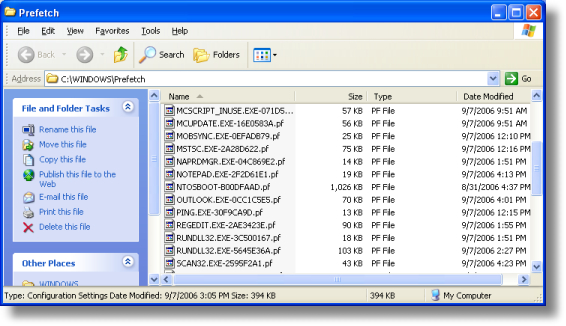
Simply browse to the windows folder (Ex: C:\Windows) and under there you should see the prefetch folder. Go into the prefetch folder and delete all the files (Careful! It should look like this c:\windows\prefetch) And here is a screenshot of one if you still have questions

The first thing to note is the next reboot will be slow. This is because windows needs to relearn the prefetch for system files. Subsequent boots will run much faster since the sludge of programs has been removed, and only new ones are in the cache.

The trouble is that it will only help you for a while - until the prefetch gets clogged up again. We need to edit a registry key to tweak it. Open regedit and browse to this key:

HKEY_LOCAL_MACHINE\SYSTEM\CurrentControlSet\Control\Session Manager\Memory Management\PrefetchParameters

Under this key you should see a value named: EnablePrefetcher

It has 4 possible values:

0 - Disabled : The prefetch system is turned off.

1 - Application : The prefetch only caches applications.

2 - Boot : The prefetch only caches boot system files.

3 - All : The prefetch caches boot, and application files.

We don't want to disable it entirely. This would actually make boot times *longer*. This is because this feature is also used to speed up the loading of boot files. That is why we are going to pick the number 2 option. It allows us to keep the advantage of caching system files, without continually clogging the system up with applications.

Set the value to 2 and reboot.

The 2nd time you boot it should boot much faster. Remember that the side effect is that launching individual applications once windows has loaded will now be slightly slower.

2. Hard drive fragmentation

Over time your hard drive will become fragmented. An over simplified explanation of fragmentation is when your files and folders are not all stored in the same spot. For example lets say you had a large movie file. If it were fragmented the first 5 megabytes are at the beginning of the hard drive, and then next 5 are at the end. It takes longer for windows to read the file than it would if it were all in the same spot. The point is that if each file is stored in a linear fashion, and the drive does not have to move all over the place to read it - it will load faster. XP has a built-in defrag tool, and it is simple to run. Open "My Computer" right click on the boot drive, and go to properties. Now click on the tools tab.

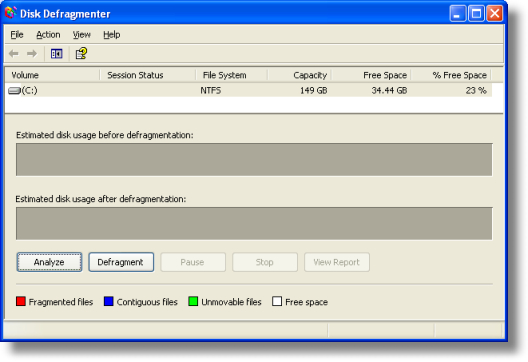
Click "Defragment Now" and the following window should appear:


Before you click on the "Defragment" button you want to close all applications and be aware that it might take hours to complete. If you leave something running it might keep windows from completing the defragment operation.

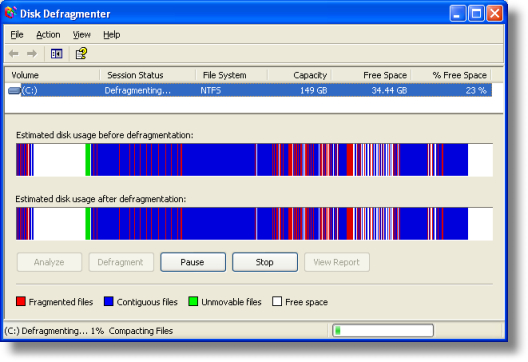
Click on the defragment button and you can walk away. Or you can watch it defrag your hard drive:

3. Disconnected network drives

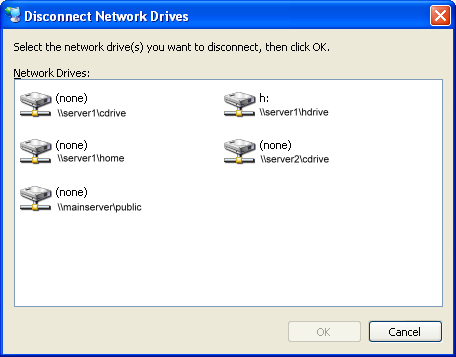
I am using networked drives all the time. If you have ever put your machine on a network and connected to a shared drive, this can slow you down too. If you have a drive that is still mapped, but cannot be reached it will slow down windows during boot time. This is because windows will wait...wait...and wait some more for the remote server to respond. To clean these out open "My Computer" and go to the tools menu. Click on "Disconnect Network Drives" It will open a window that looks like this:


Click on the drives you no longer need, and click OK.

4. Spyware & Adware

These can have a big impact on your start times. If your PC gets loaded with spyware, it spends a large portion of its boot time making sure those pesky programs are loaded and ready to throw popup adverts at you all day. To check and clean your system of spyware there are three free programs that I highly recommend:

1. Microsoft Windows Defender

2. Ad-Aware

3. SpyBot Search And destroy

5. File and Printer Sharing

One other item that can significantly impact is the "File and Printer Sharing" feature within windows. Obviously, if you are sharing your printer, or folders you don't want to disable this - so this tip is not for you. If you never use it, then why waste your time waiting for it to load?

Here is how to turn it off:

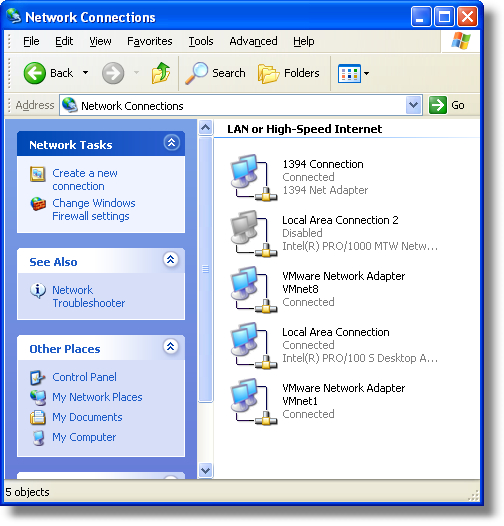
Go into the control panel. Click on "Network Connections"


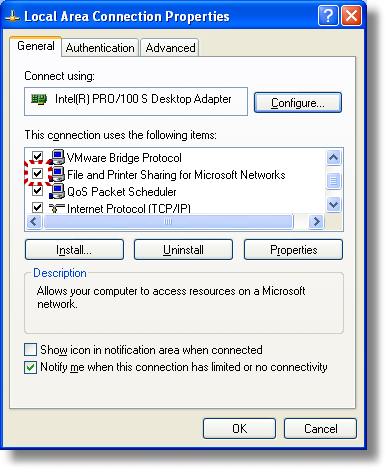
Now right click on "Local Area Connection" and click on properties

Uncheck the "File and Printer Sharing for Microsoft Networks"

Click OK, and reboot.

That wraps up our windows startup optimization. And if you are tired of waiting for windows to shutdown, then check out our article on speeding that up too!

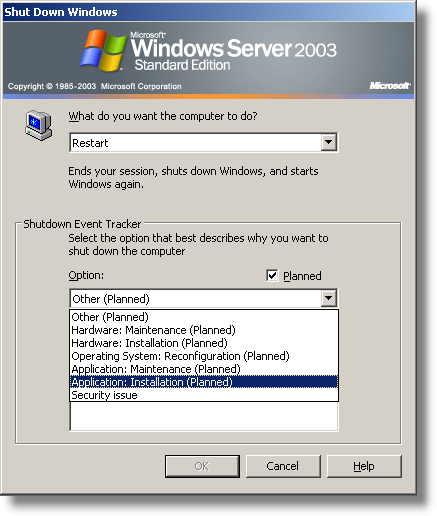
Stay tuned. We are about to release a new version of our Remote Reboot program. This version adds a feature suggested by David in our forum. It allows you to specify the shutdown reason that is written to the event log on Windows XP, and 2003. If you are not sure what I am talking about...this should remind you:

One final note, if you have any ideas for a free utility you would like to see, please put you comments on this.

courtesy : intelliadmin.com
Read More

5 Jan 2009

Mitesh

Top ten relationship wreckers

Jealousy, money, the need for space and excessive use of the Internet are just a few things that can cause relationship
10 relationship wreckers strife.

Relationships are changing faster than ever before — and so are the triggers for break-ups. New issues not even dreamt about 20 years ago, such as chatroom romances and online pornography, have risen to prominence. Here is the authoritative guide to what’s going up and what’s going down in the argument charts — and how to stop your relationship being derailed:

1. Low expectations
We expect relationships to fail. The “all men are jerks” mind set and “all women are bunny boilers” mentality has spread from being a joke with our mates into a self-fulfilling prophecy. We wait for our new boyfriend or girlfriend to trip up and then zoom in on their mistakes. Today’s couples think they are being realistic, but often this is just cynicism in disguise. Twenty years ago, couples saw marriage as an end in itself and were prepared to compromise to sustain their relationship. Therefore, they were more trusting and ready to give their partner the benefit of the doubt.
Solve it:
When people ask how many of my clients’ relationships are beyond help, my answer always surprises them: less than five percent. I believe that we make fundamentally good choices. So why so much divorce and misery? Everybody’s childhood leaves them with relationship dilemmas inherited from watching their parents’ marriage. It might be ‘not showing feelings’, ‘how to cope with unfaithfulness’ ‘temper tantrums’ or ‘attitudes to loss’ — the list in endless. We are drawn to people not just because of their great sense of humour or looks, as we imagine, but because they have similar problems to our own.


2. Work/life balance
Today we are working longer hours, doing more shift work, commuting further and therefore spending less time together than twenty years ago. When we’re tired, communication is cut down to the bare essentials (‘What time will you be back?’) as you cross paths in the kitchen. Although this shorthand is very efficient, there is no time to explain the complexity of our feelings. Into the gap leap all sorts of assumptions and misunderstandings. For example Rahul, a forty year-old chartered accountant, did not realise the importance of attending his partner’s company social. He did not understand why she was so huffy the next morning and just put the atmosphere down to a hangover but was in too much of a hurry to ask. In the past, couples would stay up half the night fighting, and probably solve the argument; today they are too aware of that early meeting to want to waste precious sleep time. Instead we complain that our partner never listens.
Solve it:
Invest in your relationship by setting aside ‘sacred time’ that belongs to just the two of you. For example: make Thursday night your date night — even if you can’t go out, spend the time talking, listening to music or making love. Many couples in therapy find they benefit most from the concentrated, quality time they spend together, rather than the counselling. Secondly, don’t make assumptions but check out your hunches.

3. Jealousy
Stories of celebrity infidelity and the divorces of supposedly ideal couples (like Jennifer and Brad) reinforce just how many people stray. Twenty years ago, we had a much clearer idea of right and wrong. But what constitutes being unfaithful today? Is it looking too long at a pretty face in the street? What about a long lunch with an admirer that you don’t tell your partner about? Is it ok if you stop at just a kiss
Solve it:
Jealousy is a sure sign of poor self image: “I’m not good enough to be loved.” Rather than relying on your partner to give
you confidence, find ways of giving yourself a boost, like going to the gym or taking evening classes. Next make a list of the occasions when you feel jealous. Try to tolerate, without resentment, the incidents that cause lower levels of jealousy. Over time, your partner will notice — probably subconsciously at first — that you have relaxed and are not monitoring him or her round the clock. He or she will then be more receptive to discussing the occasions that give you real stress — like the office Christmas party or going away on business without you. So how do you start this conversation ? First point out what you’ve achieved: “I’ve not been commenting about other men or women in the street or on television.” Secondly, talk about your fears about the up-coming event and how they make you feel. Finally ask if he or she can suggest anything they’d feel comfortable doing that might help. Agreeing to phone every evening at the same time or going away the next weekend together so there’s something to look forward to. It always feels better if these things are offered rather than having to demand them. All it takes is a little effort and understanding.

4. The internet
The arguments are not just how much time is spent on the Internet — for work or pleasure — but about starting deep ‘friendships’ in cyberspace and viewing pornography. Research among 1,500 adults found that 46 per cent believed emails, texting and chatrooms had led to a big rise in infidelity; 30 per cent had used electronic communication to flirt, or to sustain an affair; 22 per cent of them had done it every day and 62 per cent had done it once a week. In the past, few men had access to porn beyond top-shelf publications and most were too embarrassed to buy them. Today’s Internet porn is more extreme: we are bombarded with adverts for it. What’s more, the technically competent woman can trace every site her man has visited.
Solve it:
These problems need to be nipped in the bud. Long hours on the computer at home are a signal that something is wrong. Don’t ignore your instincts. Ask your partner why they need to spend so much time consuming ‘virtual’ life. They could be unhappy with your relationship together and the time on the computer is really a cry for help. So what kinds of Internet friendships are acceptable? Forums with a special interest - like Startrek or dog training — are fairly harmless but be wary of friendships made on general chat sites. Pornography is a tough one because everybody has different standards. Some couples decide to share it together and incorporate some of the ideas they discover into their regular lovemaking. Some women tolerate their men occasionally indulging, but ban spending money on the accessing pornography. Whatever your viewpoint, it is important to really listen to what your partner has to say. Unless you both truly understand each other’s opinions, you will not be able to find a working compromise.

5. Money
Different spending priorities have always been difficult, but the new twist is suddenly discovering your partner has accumulated large credit card debts. Couples today are generally less willing to have joint accounts than twenty years ago and instead use complicated systems to divide bills and shuttle money between them. For example, he pays the mortgage and for the car; while she pays for groceries and utilities. These artificial divisions are prone to misunderstanding and acrimony. Today’s couples think keeping their own bank accounts will stop arguments over one of them being a spendthrift. There will still be arguments over whether they can afford the latest iPod, but the argument is blind because in these ‘together-butapart’ financial partnerships, neither knows the real state of the others’ affairs.
Solve it:
Make a list detailing the general areas in which you spend your money, like holidays, investments, luxuries, etc. Each of you should separately rank these in order of importance and share your results. Next discuss how each of your parents might have ranked the same items, and how their choices affected you as a child. Remember money is never just about money, but intertwined with security, freedom, dependency, self-esteem and power. With a clearer understanding of each other’s fears about money, you will be better placed to agree on a budget. Next discuss having a joint household account; if you can share a life together can’t you also mingle your money? A little planning in the short run will help a lot in the long run.

6. Sex
Fewer couples go to counselling today to complain about their love life. This is partly because we are more knowledgeable and
more willing to talk about what we want in bed. However, many couples are simply too tired to enjoy sex and some can’t even find the energy to worry about it. When sex is a major issue, the most common complaint is that one partner has ‘gone off it’ — leaving the other bewildered and angry.
Solve it:
Don’t fall into the ‘all or nothing’ trap of either intercourse or a cold shoulder. Keep physically intimate - even when you’re too tired — by kissing, stroking and cuddling. This is pleasurable in its own right, not just as foreplay. Of course the fondling can turn into full sexual desire, but to start with, avoid this temptation until you have established that agreeing to a cuddle doesn’t guarantee sex. In the future, when the hand sneaks over to your side of the bed you don’t have to decide immediately if you’re interested, but instead have time to be intimate together and decide whether you want hors d’oeuvres or the full meal.

7. Space
Traditionally it’s been men who’ve wanted time to themselves, but today women burdened by work and kids are asking for ‘me’ time too. However it, is much less divisive than before as this generation of fathers (under 40) are much more involved with their children.
Solve it:
Successful couples are both team-mates and individuals, so don’t feel criticised if your partner needs space. Negotiate how often you each need time alone, and for how long, so there is a balance between ‘me’ time and ‘us’ time.

8. Children
Agreeing on the basic principals of child rearing is easy; the problems are all in the details. Fewer couples have bitter fights over their kids than 20 years ago — unless they have already split — but the stress points have changed from 20 years ago. Today couples worry about issues such as what happens when the child care arrangements break down, how much freedom it is safe to give children and how their internet usage can be supervised. Parents have always argued about what is appropriate at what age, but these days everything starts younger with, for example, pre-teens wanting to dress provocatively like their pop idols Britney Spears or Bipasha Basu.
Solve it:
Never let your kids divide and rule. Set up a system that allows you and your partner to confer before giving any major decision.

9. Division of labour
Twenty years ago, there were more arguments about gender roles at home and at work. Women still undertake more housework, but most couples seem to have reached an acceptable compromise. We are also benefiting from less of the old ‘men don’t talk’ and ‘women are better with feelings’ stereotyping.
Solve it:
If you pass on responsibility for something, you also give up control. However, if your partner’s standards and time scales set your teeth on edge try swapping jobs for something less stress-inducing . For example, if you are very picky about cleaning the bathroom and feel all the grouting between the tiles should be scrubbed every week, it is unlikely that your partner’s cleaning will meet your standards. Let him be responsible for something you are less passionate about instead, for example, loading and unloading the dishwasher. Be aware that sometimes people agree to do a job to keep the peace, but really are not that keen. Instead of speaking up, they silently communicate their dissatisfaction by never getting round to finishing jobs or deliberately doing it badly — so you don’t ask again. If this sounds familiar, you will probably also be familiar with the nagging and bitterness that accompanies it. Instead try a non-confrontational approach, where you share how this makes you feel rather than criticising, which makes people defensive.

10. In-laws
Nobody likes unasked-for advice, especially when it comes from his or her parents. However, if we rely on them for child care or financial help, they probably feel that they have a right to an opinion too. Involvement from outside is less of an issue than 20 years ago, as these days, not only do people see less of their parents , but parents are also more likely to respect our privacy.
Solve it:
Make certain your partner feels you are both on the same side in any dispute with either set of parents. You might make allowances for your own parents’ ‘little ways’, but don’t expect your partner to do the same.
Read More

31 Dec 2008

Mitesh

Happy New 2009

New Year is the time to unfold new horizons & realize new dreams,
to rediscover the strength & faith within you,
to rejoice in simple pleasures & gear up for a new challenges.
Wishing everyone a truly fulfilling 2009

Read More

29 Nov 2008

Mitesh

The siege has ended at Taj

Its been more than 57 hours now that the battle had started between the NSG commandos and the Islamic Militants which finally has come to an end. A state official says the siege has ended at Mumbai's Taj Mahal hotel and the last 3 gunmen have been killed. Over 150 people were killed and more then 300 injured when suspected Islamic militants attacked 10 sites in Mumbai.

Black-clad Indian commandoes raided two luxury hotels to try to free hostages on Thursday, and explosions and gunshots shook India's financial capital a day after the attacks.

About 10 to 12 gunmen remained holed up inside the hotels and a Jewish center, Dozens of people were being held hostage at this places.


While hostages trickled out of the hotels throughout the day, witnesses said many bodies remained inside and the two-day siege showed few signs of ending quickly. Several bodies were carried out of the five-star Taj Mahal Palace and oberio & Trident Tower hotel. According to the witnesses, attackers had specifically targeted Britons and Americans inside the hotels.


A previously unknown Islamic militant group claimed responsibility for the carnage, the latest in a series of terror attacks over the past three years that have dented India's image as an industrious nation galloping toward prosperity.


The most high-profile target was the Taj Mahal hotel, a landmark of Mumbai luxury since 1903, and a favorite watering hole of the city's elite.


At least three top Indian police officers - including the chief of the anti-terror squad - were among those killed.


An Indian media report said a previously unknown group calling itself the Deccan Mujahideen claimed responsibility for the attacks in e-mails to several media outlets. There was no way to verify that claim.

Magnus Ranstorp, a terrorism specialist with the Swedish National Defense College, said there are "very strong suspicions" that the coordinated Mumbai attacks have a link to al-Qaida. He said the fact that Britons and Americans were singled out is one indicator, along with the coordinated style of the attacks.

India's prime minister blamed "external forces."
"The well-planned and well-orchestrated attacks, probably with external linkages, were intended to create a sense of panic, by choosing high profile targets and indiscriminately killing foreigners," Singh said in address to the nation.

Among the other places attacked was the 19th century Chhatrapati Shivaji railroad station - a beautiful example of Victorian Gothic architecture - where gunmen sprayed bullets into the crowded terminal, leaving the floor splattered with blood.

Other gunmen attacked Leopold's restaurant, a landmark popular with foreigners, and the police headquarters in southern Mumbai, the area where most of the attacks took place. Gunmen also attacked Cama and Albless Hospital and G.T. Hospital.

Read More

28 Nov 2008

Mitesh

Mumbai Attacks

At least 132 people were killed and more than 300 people were injured in attacks by gunmen in India's commercial hub Mumbai.

It all start on Tuesday eve at around 9.30 when small groups of gunmen armed with automatic weapons and grenades attacked the various parts of Mumbai, including Taj, Oberois and Narmian House amongst others.Even though major attacks were carried out in sothern part of Mumbai, there were few place in the north mumbai were huge blast occurred. one of the blast took place just one kilometer away from were i stay. the blast was so huge that the i could hear the blast sound even from that distance.The cab in which the blast took place was totally decimated.

It more than 36 hour now, and situation still doesn't seems to be totally under control. the NSG commandos are trying to flush out any more terrorists hiding inside the two hotels and Nariman house.

I have been glued to the news channels from the time since this incidents took place,and looking at the events which are unfolding it can be said that this was a well co-ordinated, better planned attack targeting the countries economy.

It's not often that things in terrorism alarm me. So much is a repeat of what we see almost every day, like suicide bombings. There's no real innovation in terrorism, which is why 9/11 was so terrifying, because it was so innovative and heinously clever.

But these attacks show how a handful of men, basically using weapons off the shelf, can paralyze a city and frustrate highly trained security forces. These attacks were calculated to spread alarm and anxiety - to put it quite frankly, to unhinge things - and that's exactly what they've done.
Read More

15 Nov 2008

Mitesh

50 Interesting Facts

1. If you are right handed, you will tend to chew your food on your right side. If you are left handed, you will tend to chew your food on your left side.

2. If you stop getting thirsty, you need to drink more water. For when a human body is dehydrated, its thirst mechanism shuts off.

3. Chewing gum while peeling onions will keep you from crying.

4. Your tongue is germ free only if it is pink. If it is white there is a thin film of bacteria on it.

5. The Mercedes-Benz motto is “Das Beste oder Nichts” meaning “the best or nothing”.

6. The Titanic was the first ship to use the SOS signal.

7. The pupil of the eye expands as much as 45 percent when a person looks at something pleasing.

8. The average person who stops smoking requires one hour less sleep a night.

9. Laughing lowers levels of stress hormones and strengthens the immune system. Six-year-olds laugh an average of 300 times a day. Adults only laugh 15 to 100 times a day.

10. The roar that we hear when we place a seashell next to our ear is not the ocean, but rather the sound of blood surging through the veins in the ear.

11. Dalmatians are born without spots.

12. Bats always turn left when exiting a cave.

13. The ‘v’ in the name of a court case does not stand for ‘versus’, but for ‘and’ (in civil proceedings) or ‘against’ (in criminal proceedings).

14. Men’s shirts have the buttons on the right, but women’s shirts have the buttons on the left.

15. The owl is the only bird to drop its upper eyelid to wink. All other birds raise their lower eyelids.

16. The reason honey is so easy to digest is that it’s already been digested by a bee.

17. Roosters cannot crow if they cannot extend their necks.

18. The color blue has a calming effect. It causes the brain to release calming hormones.

19. Every time you sneeze some of your brain cells die.

20. Your left lung is smaller than your right lung to make room for your heart.

21. The verb “cleave” is the only English word with two synonyms which are antonyms of each other: adhere and separate.

22. When you blush, the lining of your stomach also turns red.

23. When hippos are upset, their sweat turns red.

24. The first Harley Davidson motorcycle was built in 1903, and used a tomato can for a carburetor.

25. The lion that roars in the MGM logo is named Volney.

26. Google is actually the common name for a number with a million zeros.

27. Switching letters is called spoonerism. For example, saying jag of Flapan, instead of flag of Japan.

28. It cost 7 million dollars to build the Titanic and 200 million to make a film about it.

29. The attachment of the human skin to muscles is what causes dimples.

30. There are 1,792 steps to the top of the Eiffel Tower.

31. The sound you hear when you crack your knuckles is actually the sound of nitrogen gas bubbles bursting.

32. Human hair and fingernails continue to grow after death.

33. It takes about 20 seconds for a red blood cell to circle the whole body.

34. The plastic things on the end of shoelaces are called aglets.

35. Most soccer players run 7 miles in a game.

36. The only part of the body that has no blood supply is the cornea in the eye. It takes in oxygen directly from the air.

37. Every day 200 million couples make love, 400,000 babies are born, and 140,000 people die.

38. In most watch advertisements the time displayed on the watch is 10:10 because then the arms frame the brand of the watch (and make it look like it
is smiling).

39. Colgate faced big obstacle marketing toothpaste in Spanish speaking countries. Colgate translates into the command “go hang yourself.”

40. The only 2 animals that can see behind itself without turning its head are the rabbit and the parrot.

41. Intelligent people have more zinc and copper in their hair.

42. The average person laughs 13 times a day.

43. Do you know the names of the three wise monkeys? They are:Mizaru(See no evil), Mikazaru(Hear no evil), and Mazaru(Speak no evil)

44. Women blink nearly twice as much as men.

45. German Shepherds bite humans more than any other breed of dog.

46. Large kangaroos cover more than 30 feet with each jump.

47. Whip makes a cracking sound because its tip moves faster than the speed of sound.

48. Two animal rights protesters were protesting at the cruelty of sending pigs to a slaughterhouse in Bonn. Suddenly the pigs, all two thousand of them, escaped through a broken fence and stampeded, trampling the two hapless protesters to death.

49. If a statue in the park of a person on a horse has both front legs in the air, the person died in battle; if the horse has one front leg in the air, the person died as a result of wounds received in battle; if the horse has all four legs on the ground, the person died of natural cause.

50. The human heart creates enough pressure while pumping to squirt blood 30 feet!!
Read More

22 Oct 2008

Mitesh

ATTITUDE

"Attitude determines altitude."

I am not quite sure who is the original author of this, but I know I
have heard it from plenty of different motivational gurus. It is
usually used to convey the message that if you want to get ahead, to
become successful, you have to have a positive I-can-do-it attitude.

But I read so much more into it. After all “success” is not the
only altitude there is. If you want to rise up and be the best person
you can be, someone others can admire for truly worthy reason, a
person you yourself can admire, adopt a sharing and caring attitude.

When we share with other people and care for other people, were rise
above the daily din. We personify the highest ideals. And no amount of
“success” as measured by dollars or titles can equal such
real-life stature.

So let’s all check our attitude for sharing and caring.
Read More